








Video Transcript
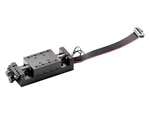
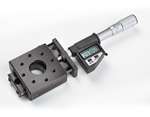
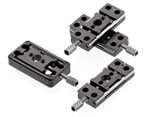
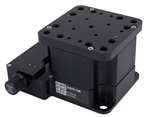
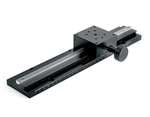
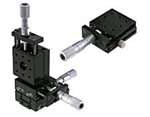
Hi, I’m Katie, one of the Opto-Mechanical Engineers here at Edmund Optics. Today I’d like to go over some of the specifications we provide with our mechanical stages so that you can make an informed decision about what stages are best for your application. Before choosing a stage, it is important to first consider if you need linear or rotational motion, or a combination, and in what directions. You can view our video on types of manual stages for more information on this. In addition to determining the type of adjustment you require, there are several general specifications to consider: resolution, load capacity, travel range, accuracy, repeatability, and wobble for rotary stages. Resolution is the smallest step size of a stage that can be measured. It is defined by the encoder, which is what measures a stage’s motion. On manual stages, the encoder can be a micrometer, a scale printed on the side of the stage, or a number of rotations of the driver, as with rack and pinion stages. The resolution is the finest control you will have with the stage, so keep this in mind with the accuracy you need to move your object. Factors that can affect what resolution is actually achieved include the load, friction, vibration, and other system or environmental factors. Load capacity is the amount of static load the stage can support without damaging the stage or sacrificing performance. It can be specified in both vertical and horizontal directions and typically assumes the load is centered on the stage. Keeping other factors equal, load capacity will usually increase with the stage size, however, larger load capacities often result in lower resolution. Travel range specifies the amount of movement a single stage can provide. This distance is typically defined by mechanical hard stops at either end of the stage. Linear travel range for our most common stages can be anywhere from half of an inch to 2 feet, depending on the selected stage. Accuracy quantifies how closely a stage moves to the location desired by the user. Straight line accuracy is specific to linear stages and describes how accurate the stage stays along the ideal axis of travel. It is typically specified as a displacement per distance traveled, for example, 2um per 25mm. The accuracy of a stage depends highly on the method used to measure it as well as environmental factors. Repeatability is defined as how often a stage returns to the same position with repeated attempts. Note that high repeatability does not imply high accuracy. Wobble is specified for rotation stages and refers to the amount of angular deviation of the rotation axis during one revolution of the stage. Please note that any specifications provided in our catalog or elsewhere have been measured and quantified under conditions that may differ from your application. The true performance that you can achieve with a given stage will depend on how it is integrated into your application. I hope this answers your questions about the importance and difference between specifications. You can browse more of our technical application notes and videos to learn more key concepts and find answers to common questions on our website.


或查看各区域电话
报价工具
只需输入商品编号
Copyright 2025, 爱特蒙特光学(深圳)有限公司 粤ICP备2021068591号
The FUTURE Depends On Optics®